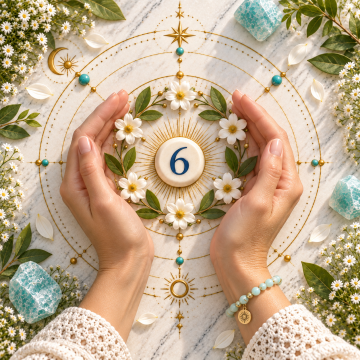
Number 6 begins when the intelligence awakened through experience recognizes that life is not a collection of unrelated events, but part of a greater order. Five seeks knowledge through movement; 6 develops the intuition to perceive the meaning and responsibility within that knowledge. It is the vibration of love, harmony, truth, justice, the will-to-good, and recognition of a Divine Plan. Wherever 6 appears in a numerology chart, it brings the need to care for life, restore right relationship, and align personal choices with a good greater than the individual self.
With 5, consciousness explores the world through the mind, body, and senses. With 6, it begins to perceive an order beneath those experiences. Events, relationships, and responsibilities no longer appear entirely separate; they reveal connections through which each life affects the whole. Number 6 is therefore the principle of conscious harmony - the recognition that freedom must eventually become responsibility.
The intelligence of 5 asks, "What can I know?" The intuition of 6 asks, "What is this knowledge asking me to do?" Six does not remain satisfied with experience for its own sake. It seeks the right use of experience: how knowledge may protect, heal, guide, reconcile, and contribute to the larger pattern of life.
This intuition is the symbolic "sixth sense." It perceives what cannot always be established through the five physical senses alone: the emotional atmosphere of a place, the unspoken needs within a relationship, the moral weight of a decision, or the direction in which a situation is naturally trying to develop. It is an inner recognition of relationship, consequence, and purpose.
Through intuition, Number 6 begins to recognize a Divine Plan - an underlying order in which every being, relationship, and experience has a place within a greater process of development. This does not mean that every event is immediately understandable or that human choice becomes irrelevant. It means that life contains meaning beyond personal preference and that individual will can learn to cooperate with a higher purpose.
The response of 6 to this recognition is the will-to-good. This is more than affection, kindness, or the desire to be considered a good person. The will-to-good is love becoming active: the deliberate use of thought, ability, resources, and influence to create conditions in which life can heal and develop.
Personal will first emerged through Number 1 as the power to act independently. Under Number 6, that will is asked to mature. It is no longer concerned only with what the individual wants to create or experience, but with whether personal action serves the well-being of the whole. Six transforms "What do I want?" into "What is mine to care for?"
This is why Number 6 is associated with love, responsibility, service, protection, family, community, justice, compassion, beauty, and healing. It naturally notices what has fallen out of balance and feels an impulse to restore it. Its care may be directed toward people, animals, nature, a home, a community, or an ideal whose preservation benefits others.
Where 5 moves freely among many possibilities, 6 forms bonds. It accepts that love creates obligations - not obligations imposed through fear, but those willingly assumed because another life has become meaningful. Through devotion, 6 discovers that freedom is not diminished by every commitment; some commitments give freedom a purpose.
The geometric symbolism of 6 appears in the hexagon and the six-pointed star. The hexagram is formed by two interlaced triangles, one ascending and one descending. It represents spirit and matter, above and below, giving and receiving, aspiration and manifestation brought into relationship. Neither triangle disappears; harmony is created through their interpenetration and balance.
The hexagon also appears throughout nature, most visibly in the honeycomb. Its repeating cells create a structure that is both economical and strong, allowing individual units to serve the life of the whole. This reflects the constructive principle of 6: separate parts arranged through intelligent relationship become capable of sustaining a larger community.
Beauty belongs to Number 6 because beauty reveals harmony made visible. Proportion, color, sound, movement, and form become beautiful when distinct elements enter a meaningful relationship. The artistic impulse of 6 is therefore not decoration alone; it is the desire to reveal an underlying order through physical form.
The same principle gives 6 its concern with justice. Harmony cannot be maintained when one part continually prospers at the expense of another. Six seeks fairness because it intuitively recognizes imbalance and understands that unresolved harm eventually affects the whole. At its highest level, justice develops into compassion - the ability to protect what is right while still perceiving the humanity within imperfection.
In Pythagorean numerology, the words truth, justice, understanding, compassionate, artist, and word carry the vibration of 6. Together they describe its complete movement: truth must be understood, understanding must become compassion, and compassion must find expression through the word, the creative act, or practical service.
The word is especially important under 6 because speech can restore harmony or deepen division. A word spoken with the will-to-good may comfort, clarify, reconcile, or awaken responsibility. Six learns that loving speech is not always agreeable; sometimes the most compassionate word is the one that tells the truth without cruelty.
Every number in a numerology chart is most constructive when its energy is expressed in balance. When any number appears four or more times across the birth date or birth name, its vibration becomes concentrated and may present a particular challenge.
At its highest expression, Number 6 is devoted without becoming self-erasing and responsible without becoming controlling. It recognizes what requires care, but does not assume ownership of every problem. Its intuition guides service toward what is genuinely needed rather than what will make it feel indispensable.
A balanced 6 understands that harmony is not achieved by preventing every disagreement or removing every difficulty. True harmony allows each part to fulfill its proper function. Sometimes care means drawing closer; at other times it means establishing a boundary, allowing a consequence, or trusting another person to carry their own responsibility.
When Number 6 is overabundant, responsibility can become interference and devotion can turn into self-sacrifice. The person may feel compelled to rescue others, manage every detail, or assume burdens that were never truly theirs. Care may be offered so insistently that those receiving it have little room to develop their own judgment and strength.
The desire for harmony can also become perfectionism. There may be rigid ideas about how a family, relationship, home, or moral life should appear. When reality does not conform to that ideal, 6 may become critical, disappointed, anxious, or quietly resentful after giving more than was freely chosen.
An excessive 6 can confuse personal preference with the Divine Plan. Because it strongly senses what could be improved, it may assume that its own vision of improvement is the only right one. The will-to-good then becomes personal will disguised as duty, and love becomes an attempt to direct another person's path.
The burden of being needed can eventually produce exhaustion or martyrdom. The person may give beyond healthy limits, refuse assistance, and then feel unappreciated when others do not recognize the sacrifice. This is not the fulfillment of 6, because service that destroys the servant cannot sustain harmony.
The lesson of 6 is to cooperate with the good without trying to control its entire expression: to serve without creating dependence, love without possession, accept responsibility without claiming every burden, and trust that the Divine Plan is larger than one person's understanding of it. Its highest gift is intuitive alignment - the ability to recognize where love is needed and allow the will-to-good to become a healing presence in the world.