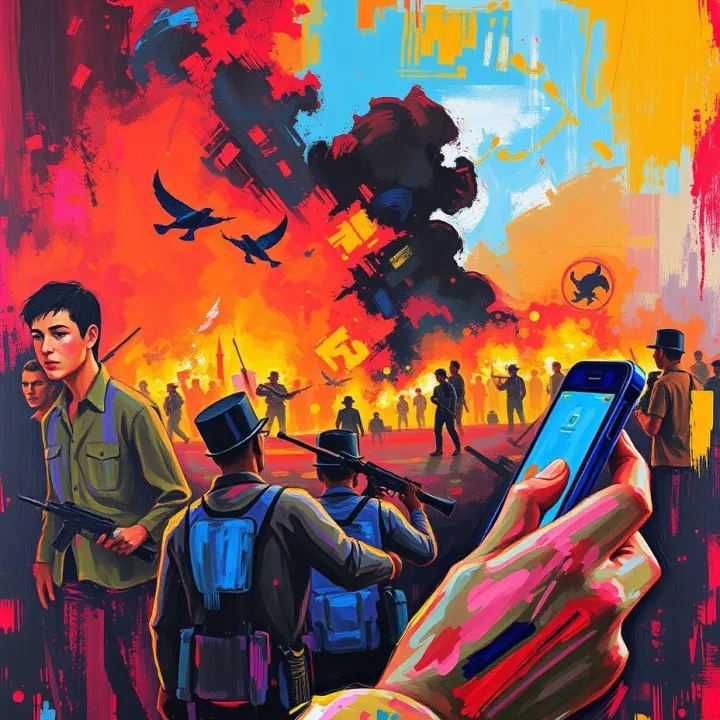
For decades, cultivation theory has described how traditional media, particularly television, can distort perceptions of danger by repeatedly portraying crime and violence. In the digital era, social media has become a far more pervasive - and far more participatory - information environment. The new study by Miaofang Guan examines whether the same gradual shaping of worldviews occurs when political information circulates through algorithm-driven platforms rather than scheduled broadcasts. The central question is whether frequent exposure to online political content cultivates a heightened fear of civil war, a rare but emotionally charged outcome that symbolizes extreme societal breakdown.
Using data from the seventh wave of the World Values Survey, covering 60 countries between 2017 and 2022, the study tests whether individuals who use social media to obtain information report greater concern about civil conflict. The dependent measure is simple but powerful: respondents rated how worried they are about a civil war in their country. Although this is not a forecast of actual conflict, the emotion it captures - fear of violent internal collapse - reflects a broader perception of political instability, polarization, and threat.
The analysis finds a small but consistent association: higher exposure to social media information is linked to higher fear of civil war. This relationship persists even after accounting for age, gender, education, income, religiosity, political interest, confidence in institutions, political extremism, and consumption of other media such as television or newspapers. While the overall effect size is modest, its consistency across highly diverse national contexts supports the argument that repeated encounters with polarizing content on social media gradually shift collective perceptions of societal risk.
The study also distinguishes between passive and active forms of exposure. Passive exposure occurs when individuals encounter political content incidentally while using social media for entertainment or communication. Active exposure involves intentionally searching for political information, following political accounts, or engaging in political discussions online. Active seekers, perhaps unsurprisingly, show lower baseline fear of civil war. This finding aligns with literature showing that active political users are generally more informed, more skilled at identifying misinformation, and better able to contextualize extreme viewpoints.
However, the more striking result emerges when exposure levels rise. As social media consumption increases, fear of civil war rises more sharply among active seekers than among passive users. Though they begin with lower fear, heavy exposure appears to intensify their concern more dramatically. This suggests that motives and media literacy do not necessarily shield individuals from the emotional effects of prolonged engagement with contentious political content. Active seekers consume a greater volume of politically relevant material, often including extreme or highly emotive messages amplified by platform algorithms. Over time, this cumulative exposure may heighten perceptions of polarization, conflict, and instability.
The study further examines how social and political contexts shape this relationship. Countries experiencing recent civil conflict, high political polarization, or intense partisan animosity show significantly stronger links between social media exposure and fear of civil war. In such environments, online information often mirrors or magnifies real-world tensions, creating a feedback loop in which political hostility circulates simultaneously on the streets and in the digital sphere. Social media may not directly cause violence, but it may amplify perceptions of danger by increasing the visibility of extreme voices, hostile narratives, and conflicting identities.
Economic development also moderates the effect. In wealthier countries, individuals generally report lower overall fear of civil war, yet the relationship between social media exposure and fear is slightly stronger. One possible explanation is that citizens in more stable environments may experience conflict-related messages as more unexpected and therefore more alarming, making fear more sensitive to online cues about polarization or unrest. The study does not attempt to resolve this mechanism, but it highlights the complexity of how material conditions shape psychological responses.
The global perspective of the study is particularly noteworthy. While most countries show a positive association between social media exposure and fear of civil war, a small number show the opposite pattern. These exceptions - such as South Korea or Cyprus - suggest that platform use may interact with cultural norms, media ecosystems, or governmental stability in ways that diminish fear rather than heighten it. Yet across the full dataset of 60 nations, the prevailing pattern is a consistent, positive cultivation effect: repeated exposure to political information online corresponds with increased fear of internal conflict.
From the perspective of Seven Reflections' Dimensional Systems Architecture (DSA), these findings illuminate how digital environments shape the cognitive field through repeated signals that alter the weighting of threat-related information. In DSA terms, social media functions as an open-field amplifier, increasing the salience of emotionally charged stimuli and narrowing the system's perceptual bandwidth. Fear emerges not simply from isolated messages but from cumulative exposure that shifts the perceived probability landscape of future events. Active seekers experience a steeper increase because their field integration is more saturated with political content, creating a stronger resonance between incoming signals and internal expectation models. In this view, fear of civil war represents a field-level response to perceived systemic instability rather than a direct reflection of objective risk.
The broader implication is that digital political communication can shape psychological climates even in the absence of real conflict. Small effects aggregated across vast populations may influence trust, policy attitudes, and democratic resilience. While social media enables unprecedented access to political information, it also exposes citizens to constant reminders of division, hostility, and threat. Understanding how these signals accumulate - and how they shape collective emotional landscapes - is essential for navigating an era in which online discourse profoundly influences perceptions of national stability.