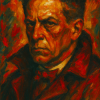
Machiavelli came from an old Florentine family of modest means. His father, Bernardo, had legal training and humanist interests, and he owned a small estate and a collection of classical texts. Niccolò received a solid humanist education in Latin, rhetoric, and ancient history, though no university degree is documented. In 1498, after the Medici expulsion and the fall of Savonarola, he was appointed secretary of the Second Chancery of the Florentine Republic at age twenty-nine. For fourteen years he handled correspondence, military affairs, and diplomacy for the republic.
His diplomatic missions took him to France, the papal court, and the German lands. As secretary to the Ten of War, he helped direct Florence's military policy and negotiated with Louis XII, Pope Julius II, and Emperor Maximilian I, gaining a close view of how divided Italian states were exposed to stronger monarchies. The most formative mission was his service with Cesare Borgia in 1502 - 03, when the ambitious papal commander campaigned in the Romagna. Machiavelli also helped organize a citizen militia in 1506, convinced that Florence should not depend on mercenary troops. When the Medici returned to power in 1512, the republic collapsed. He was dismissed in 1513, accused of involvement in a conspiracy, imprisoned, and tortured; he denied the charge and was released.
He withdrew to his small farm at Sant'Andrea in Percussina, near Florence, and turned to writing. In 1513 he composed The Prince, a short treatise on how a ruler can acquire and hold power. Dedicated to Lorenzo de' Medici, Duke of Urbino, it circulated in manuscript and was published in 1532, five years after Machiavelli's death. Its unsentimental advice - that a prince may need to use deceit, force, and cruelty for the sake of the state - helped establish political realism as a distinct approach to politics. The book's central concern is the survival and security of the state, not the ruler's personal virtue. He also wrote Discourses on Livy, a longer defense of republican government; The Art of War; the comedy La Mandragola; and the Florentine Histories, commissioned by the Medici.
Machiavelli married Marietta Corsini in 1501, and they had six children. His later years brought minor diplomatic assignments but no lasting return to high office. He died in 1527, soon after the Medici were again expelled from Florence, and was buried in Santa Croce. His reputation spread through Europe as a theorist of statecraft. The adjective 'Machiavellian' came to describe cunning and unscrupulous political behavior, even as later readers found in his Discourses a serious argument for republican liberty. The Prince remains his most famous work and a standard starting point for debates about power and ethics in politics.
Niccolo Machiavelli was born on May 3, 1469 in Floresta, Sicily, Italy. In Cardology (Destiny Cards), May 3, 1469 corresponds to the Three of Spades, making the Three of Spades his Birth Card.
In numerology, the name adds another layer to the birth-date profile. The letters of a person’s name are used to explore inner motivation, personality, expression, and the qualities they bring into relationships and everyday life. Explore how his original name Niccolò Machiavelli influences his life and personality.
Niccolo Machiavelli Quotes
Famous Taurus People
Discover famous Taurus people, from actors and musicians to writers, athletes, and historical figures. Explore their birthdays and biographies, and see who shares the Taurus zodiac sign.







View All Famous Taurus People →
Three of Spades Famous People

View All Famous Three of Spades People →