The Moment of Choice
Imagine two people facing the same uncertainty: their business is slowing, and there is a real possibility of losing clients.
The first person allows one question to multiply into many. What if I can't pay the bills? What if I have to let people go? What if everything I've built collapses? Each question invites the next, until attention is consumed by imagined futures that may never arrive. The day passes in motionless urgency - busy internally, inactive outwardly.
The second person notices the same initial thought surface: What if I lose clients? But instead of following it outward into speculation, they pause. The question is acknowledged, then set aside in favor of what can be addressed now: reaching out, improving service, exploring new opportunities. Attention shifts from imagined outcomes to present choices.
Both encountered the same reality. What differed was not circumstance, but how thought unfolded in response to it.
Where Perception Meets Thought
As discussed in contemporary philosophy, the way experience is framed often shapes how it is lived. Perception provides the raw encounter - sounds, words, images, memories - but perception alone does not determine outcome. What follows, the patterns of thought that take form around perception, influence whether an experience feels stabilizing or draining.
Two people can encounter the same event - a slow week at work, a critical message, a troubling headline - and yet arrive at very different internal states. One becomes absorbed in repetition and speculation. Another acknowledges the signal and redirects attention toward action or reflection.
Perception introduces the moment. Thought shapes how long it stays and how much space it occupies.
Why It Matters
Most people seek similar things: clarity, steadiness, a sense of direction. Yet much of what disrupts these states does not come directly from events themselves, but from how those events are revisited internally.
Old conversations are replayed. Future scenarios are rehearsed. Attention drifts away from what is happening toward what might have been or might go wrong. Over time, this repetition becomes familiar, even automatic.
It is often not the event that exhausts, but the endless retelling of the event.
This is not a failure of intelligence. It is the natural outcome of attention left without structure. When thought loops without orientation, it tends to scatter focus rather than clarify it. Energy is spent maintaining internal noise instead of supporting action, creativity, or rest.
Learning to pause a familiar loop is not suppression. It is a form of discernment - choosing where attention is most usefully placed.
Thoughts as Food
A simple metaphor helps clarify this process.
With food, nourishment is offered by the world. We do not create the apple; we decide whether to eat it, how much, and when to stop. Some foods sustain energy, others offer momentary comfort, and some leave us depleted.
Thoughts arrive in a similar way. They are shaped by what we encounter - conversations, images, music, headlines, memories. We do not choose every thought that appears, but we do influence which ones we revisit, expand, or set aside.
Some thoughts support movement and understanding. Others repeat without leading anywhere. Like food, discernment matters more than control.
Hunger or Craving?
With food, hunger and craving can feel similar, even though they serve different purposes. Hunger signals a real need. Craving often seeks familiarity or comfort.
Thoughts follow a comparable pattern. Some thoughts point toward necessary action - I should respond to this message, I need to address this issue. Others promise relief through repetition - I'll replay that argument again, I'll imagine every possible outcome before sleeping - but rarely deliver clarity.
The difference is not moral. It is functional. One supports resolution; the other prolongs agitation.
Learning to recognize the difference is often more effective than trying to silence thinking altogether.
The Three Phases of Awareness
Rather than a method or technique, the following can be understood as a reflective framework - ways people often notice changes in how thoughts relate to attention over time.
1. Observation
The first shift is noticing that thoughts arrive at all. Many pass unnoticed, carrying attention with them. Observation introduces a small distance.
When a familiar thought appears, attention rests briefly on how it enters: a phrase, an image, a physical cue. Nothing needs to be changed yet. The act of noticing alone alters the relationship.
Awareness of the doorway changes how the room is experienced.
2. Examination
With some distance established, a thought can be observed as it unfolds. Instead of being carried by it, attention follows its progression - how one idea leads to another, how emotion and impulse become linked.
Seen this way, thought appears less like a fixed truth and more like a sequence. Observing the sequence reduces its urgency. What once felt overwhelming becomes understandable.
This perspective does not remove difficulty, but it restores proportion.
3. Interruption
Over time, some people find they no longer need to follow every familiar path. When a recurring thought begins, attention may pause earlier - before the story completes itself.
This pause does not require argument or replacement. It is simply a decision not to continue. Attention returns to the present moment, to physical sensation, or to what is immediately at hand.
With repetition, this interruption can feel less deliberate and more natural, like setting something down once it is no longer needed.
Systems That Bring Order
When thought spirals persist, it is often because experience feels uncontained. Throughout history, cultures have developed systems that help place experience within a larger frame.
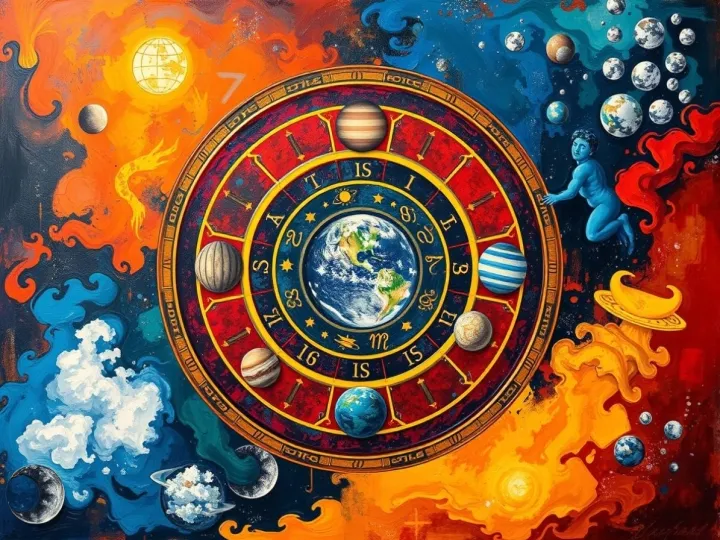
Religious traditions offer moral narratives. Symbolic systems - astrology, tarot, numerology - translate experience into patterns and cycles. Scientific models organize uncertainty through measurement and causality.
Though their languages differ, their function is similar: to prevent experience from remaining formless. Structure gives thought a place to settle.
Belief Systems as Filters
It doesn't matter whether you believe in Saturn, statistics, or scripture. Each system helps metabolize thought by giving it a framework. Without structure, we spin in fog. With structure, even pain has a place.
The believer metabolizes grief by seeing it as God's plan. The astrologer metabolizes it as Saturn's cycle. The scientist metabolizes it as a testable cause-and-effect chain. The outcome is the same: the thought no longer runs wild. It is placed, understood, and allowed to settle.
Belief systems do not erase pain - they transform pain into meaning.
Belief Systems as Filters
Whether one turns to faith, symbolism, or analysis, each system acts as a filter. Experience is not erased, but recontextualized.
Pain is no longer raw repetition; it is situated within a story, a pattern, or a process. This placement reduces internal noise and allows attention to move forward.
Structure does not remove difficulty. It transforms how difficulty is held.
From Awareness to Priority
When attention is no longer pulled equally by every passing thought, priorities become clearer. Some thoughts deserve engagement. Others can be released without loss.
This shift changes how energy is spent. Action replaces reaction. Direction replaces urgency.
Discipline, in this sense, is not constraint. It is the freedom to choose where attention belongs.
Closing Reflection
We are not defined by every thought that appears, but by which ones we continue to carry. Much passes through without consequence. What remains shapes experience.
Seen this way, pausing a thought is not mystical or extreme. It is ordinary discernment - choosing where to invest limited attention.
Across cultures and systems, the principle is consistent: structure transforms chaos. When experience is placed within form, clarity becomes possible. Clarity reveals priorities. And priorities shape the life that unfolds.