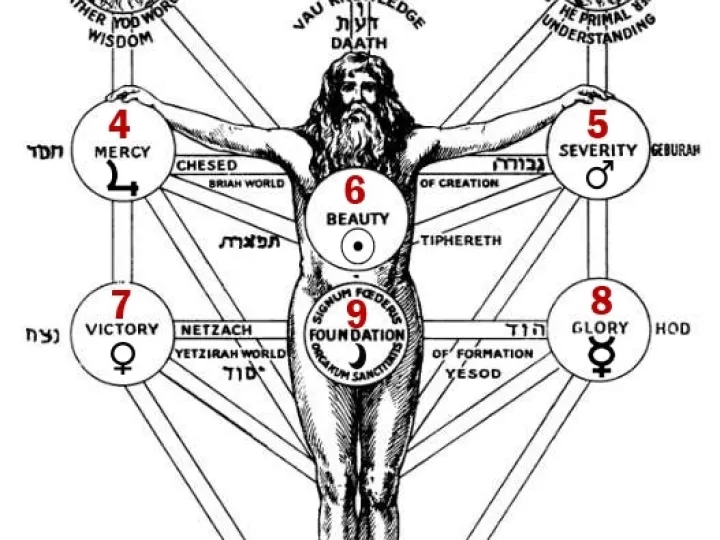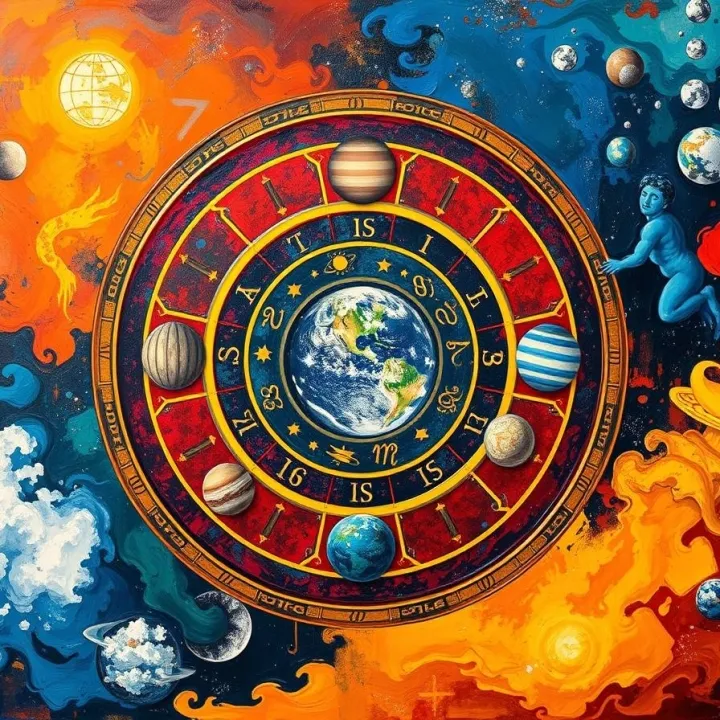
Why does a week have seven days? At first glance, it seems arbitrary. After all, we could just as easily imagine a five-day week, or perhaps one with ten or eleven days. Yet across most cultures and throughout history, the seven-day week has endured. The answer lies in the sky - and in the seven celestial bodies that ancient peoples could see without telescopes: the Sun, the Moon, Mars, Mercury, Jupiter, Venus, and Saturn.
These wandering lights became more than astronomical objects. They were gods, symbols, and timekeepers. Their visible movement shaped calendars and inspired the rhythms of human life. Even the word planet comes from the Greek plan-t-s, meaning "wanderer," a reflection of how these bodies drifted against the backdrop of fixed stars.
From the Heavens to the Calendar
Unlike the year, which is defined by Earth's orbit around the Sun, or the month, tied loosely to the Moon's phases, the week has no direct astronomical anchor. It is a cultural invention. The fact that seven days became the standard reflects humanity's fascination with the seven visible planets.
The seven-day cycle was adopted in Babylonian, Hebrew, and later Greco-Roman traditions. It spread through cultural contact, trade, conquest, and religion, until it became embedded in societies across the globe. Even today, in an era of atomic clocks and space travel, our daily lives still follow this ancient planetary rhythm.
The Names of the Days
The connection between days of the week and planets is clearest in the names we still use. Each day carries the legacy of an ancient deity associated with one of the seven celestial bodies.
- Sunday - The day of the Sun. Its brilliance and life-giving power made it the natural anchor of the week.
- Monday - The day of the Moon, guardian of tides, emotions, and the rhythms of night.
- Tuesday - Linked to Mars, the Roman god of war. In Old English, Mars was equated with Tiw (or Tiu), a Germanic war god. "Tiw's Day" became Tuesday.
- Wednesday - Named for Mercury, the quick and clever messenger of the gods. The Italian Mercoledì preserves this association. In English, the day honors Woden (Odin), the Norse counterpart.
- Thursday - Associated with Jupiter, the god of thunder and rulership. The Norse god Thor (Donar in Germanic tradition) took Jupiter's place in Northern Europe, giving us "Thor's Day."
- Friday - Dedicated to Venus, goddess of love and beauty. In Italian, it is Venerdì. In Germanic lands, Venus was replaced with Freya, giving us "Freya's Day," or Friday.
- Saturday - The day of Saturn, the stern planet-god of time, limits, and agriculture. English preserves the Roman root most clearly, though in German, Samstag and Sonnabend connect the day with the Sabbath or "the evening before Sunday."
This mix of Greco-Roman, Hebrew, and Germanic influences explains why the same planets appear under different names in different languages, yet the underlying structure remains universal.
The Symbolism of Seven
The choice of seven is not only astronomical but also symbolic. Across cultures, seven has long been considered a sacred or complete number.
- Seven days of creation in the Hebrew Bible.
- Seven classical planets of antiquity.
- Seven visible notes in a musical scale.
- Seven wonders of the ancient world.
- Seven chakras in Eastern traditions.
Seven represents a whole cycle, something balanced and self-contained. A week is thus not just a convenience; it is an archetype, a miniature reflection of cosmic order.
Astrology and the Planetary Days
Astrology carries this planetary connection further. Each day is believed to be infused with the qualities of its ruling planet.
- Sunday brings vitality and clarity under the Sun.
- Monday reflects the Moon's emotional, intuitive influence.
- Tuesday carries Mars' fiery drive and courage.
- Wednesday resonates with Mercury's quick thinking and communication.
- Thursday expands with Jupiter's generosity and wisdom.
- Friday shines with Venus' charm and affection.
- Saturday grounds us with Saturn's discipline and responsibility.
Even without conscious belief in astrology, these archetypal associations continue to shape cultural traditions - from religious observances to superstitions and work schedules.
Why Seven Endures
Other calendars have existed. The ancient Romans once used an eight-day week. Revolutionary France attempted a ten-day cycle. Yet these alternatives did not last. The seven-day week proved resilient, both for practical and symbolic reasons. Seven divides evenly into the lunar month of approximately 29.5 days, producing four neat weeks. More importantly, the weight of tradition, reinforced by religion and culture, kept the system in place.
Today, whether in Tokyo, London, or New York, people live by the same seven-day rhythm - a silent testament to the planets visible to the ancients thousands of years ago.
Conclusion
The week could have been five days, ten days, or any number at all. Instead, it became seven - a cycle rooted in the movements of the visible planets, the myths of gods, and the human search for meaning.
Every time we say Sunday or Friday, we echo ancient astronomers and storytellers who looked at the night sky and mapped their lives to the wandering lights above. The seven-day week is not just a schedule. It is a reflection of our connection to the cosmos - a reminder that our most ordinary routines are woven from extraordinary origins.