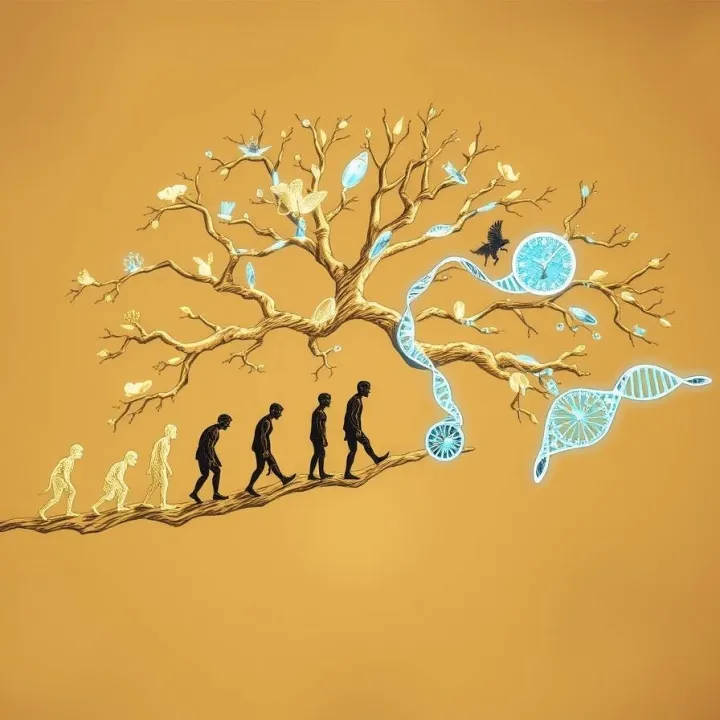
How quickly a trait evolves is usually described in simple terms: the more additive genetic variance a population has, the faster evolutionary change can occur. This is the core logic behind the breeder's equation, a foundational tool in evolutionary biology. But a new Open Access paper in the Journal of Evolutionary Biology argues that this view, while accurate in many contexts, misses a critical component of real populations: the timing of reproduction.
In species with overlapping generations, selection does not act solely on trait values - it also interacts with how early or late individuals reproduce. Genotypes that reproduce sooner contribute offspring more quickly to future generations, effectively accelerating their rate of evolutionary response relative to individuals who reproduce later. Over time, this creates a feedback loop where reproductive timing becomes genetically correlated with the trait under selection, even if the two were initially unrelated.
According to author Philipp Mitteroecker, this phenomenon means that evolvability is not determined only by variation in the trait itself but also by genetic variance in reproductive age. His work formalizes this insight using quantitative genetic theory and validates it with individual-based simulations. The result is a refined understanding of evolutionary dynamics that better reflects how real populations change over time.
At the heart of the argument is a simple but powerful observation: if two genotypes have the same number of offspring but differ in when they reproduce, their evolutionary contributions differ. Early-reproducing genotypes propagate faster, effectively shortening generation time. Late-reproducing genotypes contribute more slowly, elongating the generational turnover. Under directional selection on a trait, early reproducers with favorable variants gain an additional advantage: they amplify adaptive alleles through quicker generational cycling.
This means that selection on any trait inevitably causes some degree of selection on reproductive timing - even if reproductive timing does not directly affect fitness. If the favored trait value becomes associated with early reproduction, the population responds more rapidly to selection.
Mitteroecker's analysis shows that this linkage forms predictably through the process of selection itself. When a trait is under directional pressure, individuals with beneficial values of that trait tend to become overrepresented earlier in the reproductive timeline. Their offspring then inherit both the advantageous trait and whatever genetic tendencies produce earlier reproduction, even if those tendencies were not initially under selection.
As this process repeats across generations, a genetic covariance emerges between the trait and reproductive timing. This covariance then accelerates evolutionary change: early-reproducing genotypes with the selected trait increase in frequency more rapidly, pushing the trait mean beyond what classical models would predict.
The author's individual-based simulations provide a clear demonstration of this effect. When the simulated population experienced directional selection on a trait, reproductive age quickly became linked with the selected trait value. This linkage persisted unless the population experienced strong counter-selection favoring later reproduction. When such counter-selection occurred - for example, through ecological pressures making late reproduction advantageous - the genetic association between trait and timing weakened, stabilizing generation time.
One of the key theoretical contributions of the paper is a formal extension of the breeder's equation. By incorporating reproductive age into the framework, Mitteroecker shows that trait response depends not only on additive genetic variance but also on how that variance interacts with the distribution of reproductive timing. In this expanded model, generation time becomes an evolving quantity rather than a fixed background parameter.
A striking implication of the analysis is that episodes of strong selection tend to shorten generation time. Because intense selection amplifies the contribution of early reproducers carrying adaptive traits, populations undergoing rapid evolutionary change often shift toward shorter generations. This pattern is consistent with empirical observations in laboratory selection lines and some natural populations undergoing fast ecological adaptation.
The study also connects these findings to broader themes in life-history evolution and senescence. If selection on traits consistently favors early reproduction, the resulting evolutionary dynamics could contribute to earlier onset of aging processes or reduced longevity, unless balanced by ecological or physiological constraints. Conversely, environments that reward later reproduction can slow evolutionary response and stabilize generation time, producing different life-history trajectories.
Mitteroecker emphasizes that these effects arise even if the trait under selection has no intrinsic relationship to reproductive timing. The link is created by the evolutionary process itself, not by any functional coupling between the traits.
This insight shifts how biologists might think about evolvability - a concept that is often treated as an intrinsic property of a trait. Instead, evolvability becomes a property of the trait embedded within the demographic and reproductive structure of a population. The evolutionary potential of a trait depends not only on its genetic variance but also on the temporal distribution of reproduction and how that distribution evolves in response to selection.
The paper concludes by highlighting empirical contexts where this mechanism is particularly relevant. Species with overlapping generations, variable reproductive schedules, or plastic developmental timing may all experience significant shifts in evolvability due to reproductive age dynamics. In such populations, classical models may underestimate or mischaracterize the pace of adaptation.
Within Seven Reflections' Dimensional Systems Architecture (DSA), the study illustrates how traits do not evolve in isolation but operate within a dynamic field of temporal structure. Reproductive timing acts as a system-level dimension that modifies the trajectory of trait evolution, analogous to how timing parameters in DSA shift the rate at which cognitive or systemic states transition across fields. Evolvability, in this view, emerges from the interaction between trait variance and temporal-field variance.
DSA emphasizes that systems evolve faster when transitions occur earlier or more frequently. Mitteroecker's analysis mirrors this principle: early reproduction increases the temporal frequency of adaptive updates, shortening the "evolutionary cycle time" and amplifying directional change. Evolvability is thus not merely a property of variation but of system timing, reinforcing the DSA principle that structural and temporal dimensions must be jointly modeled to explain change.